

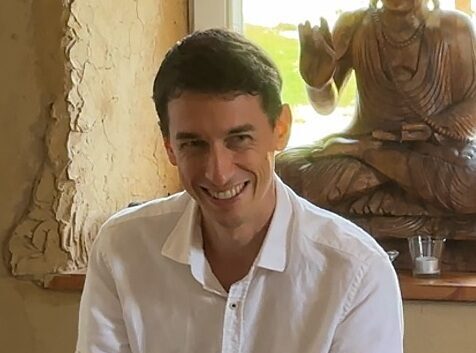
Besides some mutual playfulness, we soon found ourselves discussing themes of learning and discipline, which we clearly share. Andre’s approach and outlook on life inspire me enormously to… let’s say, “get the most out of it.” Besides crucial knowledge, I learned from him to make things specific, to ask questions, and to understand the value of formulating knowledge myself.
I took the plunge and continued our conversation in an interview I conducted with him midweek.
Dear Andre, let’s first introduce you. Can you briefly, in some highlights, tell me what brought you to Vedanta?
The search for truth. A search for truth is a long journey, it involves lots of hoops and errors and trials and errors and falling up and down. And being surprised that most of the things that are promising, are not working. They are incomplete, they are partial, and they lead me to continue the search.
And so, I needed something that makes logical sense, something that addresses my emotional life, something that doesn’t contradict my experience, and also is keeping with something that you can’t negate. I should not be able to negate it from any standpoint. If it’s negatable, it can’t be the truth, it can’t be absolute.
And a bit story-wise, when did you discover Vedanta?
I discovered Vedanta in 2017 right after finishing “A Course in Miracles: 365 Day Workbook” which I practiced for a year. It taught me to see the world as an expression of God and to change my meanings towards things. It taught me to see more then just the “world”. Soon after, I picked up a book called Arunachala [City in South India, where Ramana Maharshi lived] which was recommended to me by my girlfriend who I broke up with, because I was only thinking about moksha [freedom] around 2016. But she told me to buy this book. In that book was an interview of James Swartz giving commentaries about Ramana’s teachings (who I revered for years). I looked him up on Google, and he had a 25 day seminar at Arunachala which I attended. That was my first official entry into the Advaita Vedanta tradition.
So actually, before you came to Vedanta you already had the idea of freedom in your mind.
For over 10 years and that freedom was a drive that got me to Buddhism and Neo- Vedanta and so many things.
Did you know already at that time, what you were looking for?
Enlightenment. Enlightenment.
And when did you discover it is knowledge, it’s all about… Did you discover it in Vedanta or did you somehow knew that?
I discovered it specifically in Vedanta that the missing ingredient is knowledge and it is the glue that holds it all together. Without knowledge, I discovered, experience is fleeting.
For what reason specifically knowledge?
For what reason is it specifically knowledge? Yes, why knowledge? Because knowledge has to show me. It shows me something that doesn’t contradict my experience.
It’s an authority that says this is what reality is. So, if I keep on second-guessing through my personal experience, there will always be comparison. As long as there’s comparison, there’s doubt.
As long as there’s doubt, there’s no peace of mind. And as long as there’s no peace of mind, the search continues. So, knowledge provides a framework of authority and amongst that provides a means to, quote, ‘get there, to arrive to that vision and to abide in that vision of the truth’.
We also need knowledge because we are looking for something which is already the case, no?
Yes, so knowledge is something that answers and stops the search. Any search about anything, even the search for being a good communicator, that search stops by gaining knowledge about the subject matter.
Because if I don’t know what is to be done, how is to be done, and what it’s supposed to be – then we just keep on second guessing ourselves, living in doubt.
So, knowledge unravels or unfolds the means by which something is supposed to be done. If I don’t know it, then the search never ends.
So, a human being actually always is working with knowledge in every action too?
Yes, we’re always working with knowledge, knowingly or unknowingly, even to devote to something. One has to learn through knowledge mantras, the proper conduct, the proper means of approaching the alter. So, anything really just is a removal of “I don’t know”. That’s all we do; we just remove veils keeping us from not-knowing what-is.
And when we do that, we gain peace of mind. Now we’ve been doing that for such a long time that the one thing that we’ve been missing out is I don’t know in reference to who I am and so Vedanta removes the I don’t know in reference to me, the seeker, and thus it brings the peace of mind.
That’s so clear, thank you. Just a bit of a leap now about you personally. Can you tell me specifically about your daily schedule, just a normal average day, to look a bit into your life.
My day now is really an immersion into learning. I’m a learner and I like courses on Sanskrit, on programming, biology and science.
And my day involves waking up, meditating without a miss for 10 minutes. Right after that, I will drink protein powder, go on the soccer field, and run for 30 minutes.
Every day?
Every single day without a miss, except on Sunday. Although even on Sunday, I will run in the house. So, I’ve been running for more than half of my life. That’s over 20 plus years. And then on the soccer field, I will spend another one and a half to two hours listening to podcasts. I like to listen to Blinkist [Get key ideas from
books, podcasts, and experts in 15 minutes].
Even while running?
Not while running, after running. So, any kind of audio that’s inspiring biographies, history lessons. There’s audible by Amazon. Okay, so anything that involves education.
Okay, and further on the day, you come from soccer field…
And then coming back, I would then go straight into planning a lesson, planning a course, or just doing my own hobbies, mainly computers. I like programming or learning a language. In this block of time there’s also room for Vedanta or developing my skills. Yes, so basically most of my day, I would say, 90% is studying. But that studying is not Vedanta, because you don’t study Vedanta.
Vedanta is a way of life. It’s an understanding of what-is. So, I don’t study way of life, I study personal things that I enjoy, like History, Geography, Astronomy, Mathematics.
That was your afternoon block, so to say. And in the evening, this study continues? Or you have means for relaxing?
My means of relaxing is studying. I never stop studying. Every breath is conscious and spent in learning. This is for over 20 years.
You told us you were meditating two times a day so you end the day with a meditation
Yes, and then the days ended with the same meditation as I started in the morning, and I used to pray for myself, which I stopped. Now I pray for my dear students. So, I think of my students and may they have the knowledge. May their lives be freed and reconnect to what’s important.
I feel this yearning for learning with you, and it inspires me a lot. And I want to thank you for that. But what’s your experience of it now, is it not some automatic thing? Is it like ‘You just learn’ or is it ‘You need to learn?’ It’s a different thing to have to need to learn or just learn.
Sure, it’s just learning and that is because the person just has a mind that is curious. And if it is not inside my house, it is while I am having a great time with friends.
There’s no need to learn over there. They all just play. But at home, I’ve associated that place to learning.
Is it a joy for you?
It’s the only relative joy for me in life. So, wherever I go, I like to learn.
I remember we talked about that this week. But it’s a typical experience also, no? In this subtle world you’re in when you’re learning, subtle world of the intellect.
Yeah, it’s what makes the person constantly strive for more and better and contributing, being a better contributor to the world. So, my motivation for learning is just to contribute and be a good teacher.
Can you tell me something about becoming a Vedanta teacher, how this process came and what was your inner process?
So becoming, I would not say it’s becoming, I think to become something one needs to think over it and kind of have this personal investment in it. For me, it’s more like being thrown into it, not even wanting to be thrown into it.
I think that when, through the Vedantic teachings, the knowledge was crystal clear, then there was just a spontaneous inclination to go and share this. And I think a Vedanta teacher is not someone who chooses to be. They already have a personality that is relatively competent at talking, at teaching, at presenting. So that simply gets transferred onto Vedanta.
Of course, it’s being gifted, being talented like this, there has to be a recognition of your talents.
Yes, and the recognition of the talents is evident while teaching. So teaching is one of the fastest ways to recognize where my gaps are, where my holes are.
And sharing also, even in groups on the side of the students, also provides that opportunity. For example, I spent time in Chinmaya in Kerala and there I thought I was competent. But then when we had to share these basic ideas in Sanskrit, I didn’t know a lot of basic Sanskrit words and though that is not important to teach in the Western world. I still felt like it was necessary to do justice to the tradition by learning these basic words from the Tattva Bodha and thus as far as, quote, ‘becoming a teacher’ I would say it’s more of making sure that your knowledge is well-rounded and in line with the tradition. And also, one more thing: For a Vedanta teacher to teach, they need someone to hold their hand; this is crucial. A close relationship with their own teacher. If you don’t have a relationship with a teacher in those initial years, I don’t know how can one confidently teach.
You also had talked about insecurity a little bit because of people judging you because you’re young, you’re young and gifted. I also see you as an ambitious person in life, so how do you combine these words?
Sure. I mean being ambitious certainly has its advantages because it makes you pull through hardships. And people are not comfortable with this because sometimes they see this mirror in themselves.
This man is very motivated, they’re very courageous. And so, there is a tendency sometimes to judge or see them as you know. At least see me as I’ve experienced myself as incompetent or dismissive and the beauty is every time I got rejected, I definitely stepped up my game. In other words, I learned to just do my part and build this immunity over people’s judgments.
Perseverance is important for you, no? It’s an important quality, of course?
Yeah, so perseverance definitely is the number one quality that has or is needed by the Vedanta teacher or aspirant of figuring things out.
You don’t come from a specific wisdom tradition, culturally, and also not your home situation, you told us. You had to figure this out all by your own?
I figured it out already around 19.
There was a wisdom that already was passed through somehow, there was already an inner wisdom, but there was a lot of doubts and uncertainty, and there was a lot of curiosity and ambition to discover.
So my culture, my lineage was developed through refinement. What works and what doesn’t? We call this deduction. Deducing what doesn’t work, sticking with the next thing, the moment there is a hole, then if that hole is unpluggable, I would move to the next.
And this takes one to eventually Vedanta, at least it did for me. So, it’s using a lot of logic and rationale and discernment. And that’s what helped me, that’s something that I feel I took from since a child.
And it must also be a karmic thing, somehow. I mean, people like you are quite precocious. At an early age they recognize things, that some people only discover at a later age or not at all in life. That may be the X-factor, the grace-part of it.
Perhaps. There’s two people, one of them is just able to remove those gaps very quickly, the other can stay there for much longer.
There is, you could say, a karmic pass-over that a person carries. A thinker for instance is passed over.
You studied two years or so at Chinmaya Mission. The next thing is, I think, the yellow rope. Sevika, Brahmacharya and then the formal process continues. You lived a very disciplined life. Have you ever thought of becoming a formal Sannyasi, a Vedantic monk?
About 2019, I went to Swami Paramarthananda, to Chennai, specifically asking him for sannyas. And he asked me a question. He said: ‘Andre, do you want to be popular, or do you want to connect to people?’. I said: ’I want to connect to people’. And he also said, ‘Then stay as a householder’. He also said: ‘The Sannyasi tradition is only valid in India. It has no place in the West.’
Though you see some Western people becoming initiated?
But he told me this specifically. And it is true, it’s from a Vedic culture and I agree now, the West doesn’t have a place for it. It is an environmental, Sanyasi’s environmental, it’s within India. So that was all I needed to hear to remain as a householder.
Okay, cool. Then we have Swami Chinmayananda, Chinmaya Mission. Yes. We have Swami Dayananda. Yes. And Paramarthananda, coming from Dayananda.
Who’s your teacher?
My teacher would be Neema, Swami Paramarthananda, Advayananda (from Chinmaya), James Swartz, Swami Dayananda. But the main one is Neema.
She’s a disciple of Dayananda.
She attended, I think, 1996, around there, a three-year course. And she went back working for the United Nations and began teaching full-time around 2012, I think.
Okay, before asking about your relationship with your guru Neema. Can you say something about development of Vedanta and differences between Chinmaya and the way even maybe Chinmaya mission teaches nowadays and Dayananda, Arsha Vidya?
Sure, I can because I spent a long time with both of them and there is a clear, a distinguishable difference. I will not say that either is better or worse, just different.
If I wanted to get to the truth, using the methodology and trusting that the methodology is laid out as it should be laid out, I would go to Dayananda. If I want to understand the truth, I would go to Dayananda.
My impression always was that Dayananda’s knowledge is very precise, but you say Chinmaya (Mission) is best for becoming a teacher?
I just want to make this clear, both are absolutely brilliant traditions. Just in my personal experience, what touches me, my heart, what touches me to the core, what speaks directly to my identity is the Swami Dayananda tradition.
And what makes me look at the details and the devotion and the culture that is integrated in Vedanta, Chinmaya would be for that. And for a teacher, I think both are great.
If I was just looking for the truth, I would just go straight to Dayananda.
It is a great blessing they’re both here, no?
Yes.
Can you say something about what Swami Paramarthananda added to this, regarding style or content?
If I wanted to teach Vedanta and get all of the understandings and how terms are connected, I would learn from him. In terms of it affecting me, transforming my life, I would go to Dayananda. I’ve taught Swami Paramarthananda’s knowledge for three years in my first Bhagavad Gita course.
But I personally have not been emotionally moved by his language. I haven’t experienced a direct moment to moment transformation that I can concretely feel throughout my being. Though him, I’ve been educated in a scholarly way, but my heart has not been moved. Whereas Swami Dayananda’s language makes me think, feel the devotion for the Lord, and makes me apply it to the modern world. This of course is personal experience.
And about Neema, can you tell me something about her and her teachings and what she means to you?
She brings the emotional side to the whole teaching. She brings order and balance. What I mean by that is she takes me out of the head. She transfers this knowledge from intellectualizing it into just feeling the presence in life. Just that emotional aspect that completes the person.
For instance when I started out with my first teacher which was James Swartz, at that same time, I was with Cinmaya Int. Foundation. I was very much in my head, and I feel this is because male teachers tend to speak a lot of logic and their manner kept me in the head. So Neema was the only teacher that took me out of the head and into what they would call in the Western world the “heart” and what this really means. It’s like the brain and the heart shaking hands.
I call that the full diffusion of the knowledge. The knowledge is diffused throughout my entire being. So, before she came I felt the knowledge was almost kind of like in one place. Like stuck in one place, or just held in one place.
When Neema came into my life, that knowledge diffused all over. And I feel this is because she touches the heart. She’s able to do that. While lot of men teachers speak facts, logic, reason.
Okay, you say many men are focused on logic and reason. Now this daring question. Can we say that what she triggered in you is related to the fact that she (Neema) is a woman? It’s a good thing that more and more swaminis are entering the field.
Correct. I needed a female figure in my life. And so, she was able to penetrate what male figures couldn’t do. No matter how great they were, she’s the only one that did it.
Thank you. Not every teacher has a teacher. They have had teachers, but don’t go to their teacher anymore. But you do. You have a teacher. What does it mean to be a teacher and being taught?
You mean, what does it mean to be a teacher and to be a student?
To be also a student, yes.
I think it’s perfect balance. It keeps the person completely sharp, completely humble. It doesn’t allow them to put themselves into this accidental role of superiority, of self-righteousness. And so, it keeps a perfect middle ground for both.
Does she coach you too? Typically teaching issues maybe?
No, not anymore.
Did she?
There is not much that I’m learning from my teacher now. She’s just there as a kind of a reminder, once in a while, this is the right path. I think there’s a certain time where a person, at least a teacher, is self-competent and they’re able to just flourish on their own. But it still, like I said, requires some reminders.
You guided us yesterday in such a gentle tone how to see the world as Ishvara. What role plays devotion or love in your experience actually?
Devotion is personal. It has no particular how it looks like or what it is. It’s something that you discover within yourself how to relate to divinity all around you. For me, it is just in a form of gratitude, in a form of talking to God, in a form of seeing. When I see an object, when I see a person, I cognitively and effortlessly recognize there is more than I see. That’s a cognitive understanding.
Is it also an emotion, like enchantment, maybe?
See, this is why I say this devotion is very personal. Yes, and so however it is done for you, it invokes some reverence, some emotion in you. There’s no particular technique that I can share.
No, but I’m informing specifically how it is for you.
There’s gratitude. There is appreciation, there is doing the right thing. Because devotion, by definition, is devoting to something else. That’s what devotion is. Me, I am devoting to that. That’s the only way devotion can work at the level of the empirical.
So I recognize there’s a presence of Ishvara and I do the right thing, I do the best that I can. I give my absolute best until I am tired. That is devotion for me, giving the best that I can.
Many of your students are modern worldly householders, no? Can you define a modern inquirer compared to a traditional one? And what are main obstacles for typically modern inquirers?
I would just say that both modern and traditional inquirers are in reference to Vedanta, in reference to the truth, exactly the same. It is asking questions. It is getting to the bottom of the issue. It is willingness to discover perspectives, to shift perspective. To shift perspective requires thinking, it requires questioning. Whether one is traditional or modern, the content may change, but the intention is the same. The type of questions, the culture may change, but the underlining desire for inquiry is the same. It is what is the truth.
Okay, let me rephrase the question. A householder in ancient times and a householder now, they have different challenges, I guess. They’re in a different field, no?
Yes.
Could you talk on the specific pitfalls or obstacles for modern students and inquirers?
Well, modern obstacles or obstacles in general are modern-life distractions.
This means that a person has to make inquiry more of a lifestyle than of a scheduled task. If it is a scheduled task, that is not going to give them the satisfaction.
But if they can learn by questioning, to develop a questioning mind, then inquiry becomes natural. In that sense, challenges are never an obstacle to inquiry, because inquiry is what solves challenges.
So unless a challenge stops an inquiry, A person cannot afford that a challenge stops an inquiry, because they want to come out of their challenge. To come out of the challenge, you need to inquire.
Can we say modern people facing challenges in normal hectic life, and Vedanta practitioners, need the same kind of qualifications to be successful? Discipline for example?
Yeah, to inquire you definitely need, as I said, an inquirer’s mind. It’s not a scheduled task. You need to have that kind of personality. Everyone can develop this. So, as far as challenges are concerned, it is really just learning to ask questions.
Most people are simply not masters, they’re simply not qualified, or better phrased: ‘They don’t ask enough questions’. And so, even a question becomes a strange thing. And yet, the entire truth process requires a questioning, critical thinking mind.
Aristotle, Plato, they were just teaching ‘question everything’. Question your experience, question the world, question your ideas, question your behaviors, question society, question the government. So, it’s really just having that natural mode of questioning.
The challenge is always going to be different, but the questioning doesn’t stop. As far as discipline is concerned. So, whatever is required is that the person questions, that is what’s required. Whether it’s discipline, whether it’s a lifestyle, whether it’s simplifying your lifestyle, the point is a questioning mind.
What leads to that questioning mind, this is something that you can develop through time. Like the Bhagavad Gita talks about sattva saṁśuddhi, having a pure mind. That’s the answer. Having a pure mind. Having a pure mind why? To be able to have the time and the interest to ask questions. As long as the mind is concerned with modern challenges, modernity and social media and browsing the web and passively ingesting information, it’s not going to be asking questions.
So what I suggest, to come back to inquiry, is to create questions. With AI today, we can create questions.
That is fun. I just wanted to talk AI. You use AI in relation to the teaching.
Yes.
How do you use AI? What are the advantages and what are the disadvantages?
AI disadvantages are: It takes away a questioning mind. And to negate the effects, as we have seen with schools now, they’re reporting that kids are losing basic critical thinking skills because they’re not asking, they’re not inquiring, they’re getting the answers provided for them.
And while it’s convenient in the short term, long term, it is not useful and it’s not beneficial for the person at all. Because they are unable to see the depth of life.
AI, in my view, is wonderful once you have already taken the hard work and the research on your own.
And then AI can fill in your gaps.
Well, that’s a specific question I want to ask you. Because a beginner has trouble to verify, of course, what AI is saying. Although it’s very intelligent and fed by a guru’s input, still verification is…
Verification nowadays is not a problem.
Even in Vedanta, because it’s such precious and important knowledge?
Yeah, verification I found personally is not an issue anymore. It will give you satisfactory answers, even in Vedanta. They may use words like soul, which we never use in traditional Vedanta.
However, going back to the topic, AI can be wonderful to generate a curriculum if a person wants to learn Vedanta, then they could say something like: ‘What are the five top qualifications that I need?’ or ‘How do I bring this knowledge into my life?’ Or ‘What is the difference between this and this?’ In fact, when AI first came out, there were still some questions that I had in Vedanta because my teacher would not answer, she just wasn’t interested in those topics.
But I was interested in what is Hiranyagarbha, what are the devas, you know? And once AI came, every one of those questions was perfectly answered.
And do I feel lucky that I’ve taken the time to personally research? Absolutely. Because, as I say, the harder you struggle to discover something, the more you struggle, the more you learn it.
AI doesn’t give you a chance to struggle.
The longer you take in writing a book and the more you spend time writing an article the more you immerse yourself in that process and that process builds connections in the brain and it makes you rethink how much you understand because of your struggle to put it together to bring the sentences in the right order.
That very struggle is the very benefit that we receive in our lifetime. Like in the Bloom’s taxonomy. He talks about that the bottom is memorization. That is the least effective according to his decades of research. That’s the least effective way to become, you know, a competent person, just to memorize. Right at the top, as this pyramid goes up, the more one struggles. And what’s right on top of the pyramid?
Create. To create something means I have to now rethink and put it into my own words, keeping with the original and to put it to my own words requires lots of brain power. And that brain power restructures your brain. And that very restructuring makes you this thinker, this inquirer that we’ve been speaking.
Yes, so you use Bloom’s taxonomy (learning model) in your lessons too, no? How specifically? Can you tell me how?
Bloom’s taxonomy is used on students by creating questions. And formulating these questions are helped by AI. So, I will take my notes and I will put those notes in the AI and I will say: ‘Create five unique questions based on this material and then I will look at those questions. And most of the time they are not that great. But I will use the template of those questions, and I will modify it. And then present that to the dear students.
So, they can create.
So they can create. And so I want them to ‘struggle’, because struggling leads to effective learning. Struggle leads to effective learning.
You did, on your website, you have a specific Vedanta tool with AI, a specific prompt. How about that one?
On the website, there is a tool for AI, and this tool was made for the reason that I’ve been saying earlier, helping fill the gaps of those students who don’t have a chance to have their questions answered any other way. And so AI has become quite used. Users are happy, and the word is spreading.
So there is a clear market, there’s a clear need for this kind of instant response AI. So, this was designed specifically to aid those who are, you know, wanting these answers. And they just don’t have the inclination to ask a living teacher, or they just feel more comfortable online.
Talking about these modern things and the future. The future is up to Ishvara of course. But if you can make a vision on Vedanta, where would Vedanta be in 10, 20, 30 years? Is there some danger? Has the tradition been specifically protected, or do you think it will roll out by its own dynamics? And do you see Vedanta growing maybe?
I think that Vedanta will always be a niche. It would be a focused niche amongst those that have a qualified mind. Whether we’re speaking in the past, the present or the future I think that Vedanta will always remain a niche. There are those even in so-called non-duality, when they hear Vedanta, they don’t know what it is.
So they think this is, you know, this is not for us. And even in India, we have the six schools of philosophy. And even there Vedanta always remains the smallest, least known niche of all.
Still we’re talking about something totally universal. But what makes Vedanta unique then?
What makes Vedanta unique is that it doesn’t talk about a belief system, it talks about the reality.
The reality is something that you can’t claim. I can’t claim air; you can’t claim sun. Neither of us can claim existence because it’s evident. They’re not something that I believe in, it’s something that I observe. So the place of Vedanta is recognition of what is available. It is just being missed out, because we’re distracted or the scores are simply not pointing to that pure truth, to the crux of it.
They may talk about facets of it, but in terms of what it is like: [raises tone] ‘here’s what it is. Like explicitly: ‘here it is what it is’. That’s what Vedanta is. And sometimes it’s too much for the mind. Because the mind wants to hear more kind of sometimes devotion or chantings or something that’s gentler.
So again, it is a niche and a niche will always require a specific mind. A ready mind to ascertain these teachings. So that’s why in chapter 9 Krishna in the Gita calls this very knowledge we speak of rāja guhyaṁ rāja vidyā. In other words, it is the king of secrets, and it is the king of knowledge. So even though it’s in the open, it is still a secret. Now Krishna said this thousands of years ago. It was open secret then. It is open secret now. What about the future? Well, you could have asked me this question 500 years ago.
Yes, but there’s something intriguing me now. Because truth is revealed by knowledge. But it’s also part of the plan, part of the setup, that there is something like Vedanta. So, does a means of knowledge ‘to get out of the matrix’, has to be in the matrix? So that it will always be there? Is that a logical statement?
I would say it’s logical as far as observing what is and jotting it down. In other words, gravity is always going to be there. And whoever manifests on a planet with this gravity, they are going to observe, in a certain state of calmness, an object being pulled down and they’re going to think what is this invisible force that’s pulling down an object. And they’re going to document that. So as far as Vedanta is concerned, that is exactly what Vedanta is. It’s just observing what is already available. We’re just too busy to recognize it, because as I said earlier, we’re distracted.
So Vedanta always finds itself in whatever creation, because creation is always governed by laws and there’s always an observer and a thinker in those laws who’s going to say, hey, I’ve never thought about this.
This is true.
Then, Ishvara has to give answers then. Questions are being asked, no?
Questions are being asked, and Ishvara is always giving the answer. We’re just starting to listen.
We start to listen, and we go, ‘oh, the answer’s always been speaking to me’. Gravity has always been speaking to me. I was just not hearing it. So, Vedanta is like this.
You like word games no? Please answer only in three or four keywords. How does an Andre Vas satsang look like?
‘Love of my life’.
And finally: ‘Does it matter or does it not matter?’
It doesn’t matter, and it matters.
(Laughing, shaking hands)
OM TAT SAT
8 Responses
What a beautiful conversation I am reading here. Bhakti for learning. Out of curiosity. And how that fills daily life. Discipline, disciple… a fellow student said so beautifully 🙏🏽 in our recent retreat. Nothing is mandatory, but you go for it… that is the curious nature. Thank you Andreji and Simon for this beautiful insight into yours.
It was a brilliant idea of yours to interview our teacher, giving us even more insight into an extraordinary person and a great source of inspiration. Your curiosity was palpable and resulted in good questions. I’m looking forward to part 2, Simon…because the questioning should never stop, if I understood Andre correctly.😉
Thank you Modita and Jens for kind responses. Well, we’re all one manifesting as many, so to say, so questions are universally asked! Hehe…
A wonderful interview, thank you Simon and Andre. It clarifies insights I already had, but which have become more conscious through this interview. For example, how important it is to be curious, to ask questions, to study, and to do so with the unwavering intention of finding and living the Truth. It inspires me and confirms that I am on the right path. Thank you!
Wow, really beautiful interview! Congrats Simon and Andre.
If anybody is curious, I uploaded a few interview videos with Neema on her channel: https://www.youtube.com/watch?v=rqzU6hvo2mc
Great Georg,
Another thing, I remember your question about evolution of subtle elements to subtle body. Recently I made a scheme. You can find it here, in my article on the subtle body: https://vedanta.nl/en/glossary/suksma-sharira/
Hello Andre and Simon,
What a clear and enlightening conversation. Valuable explanations and useful encouragement. It’s great to receive this. Thank you both!
Iris and Harry